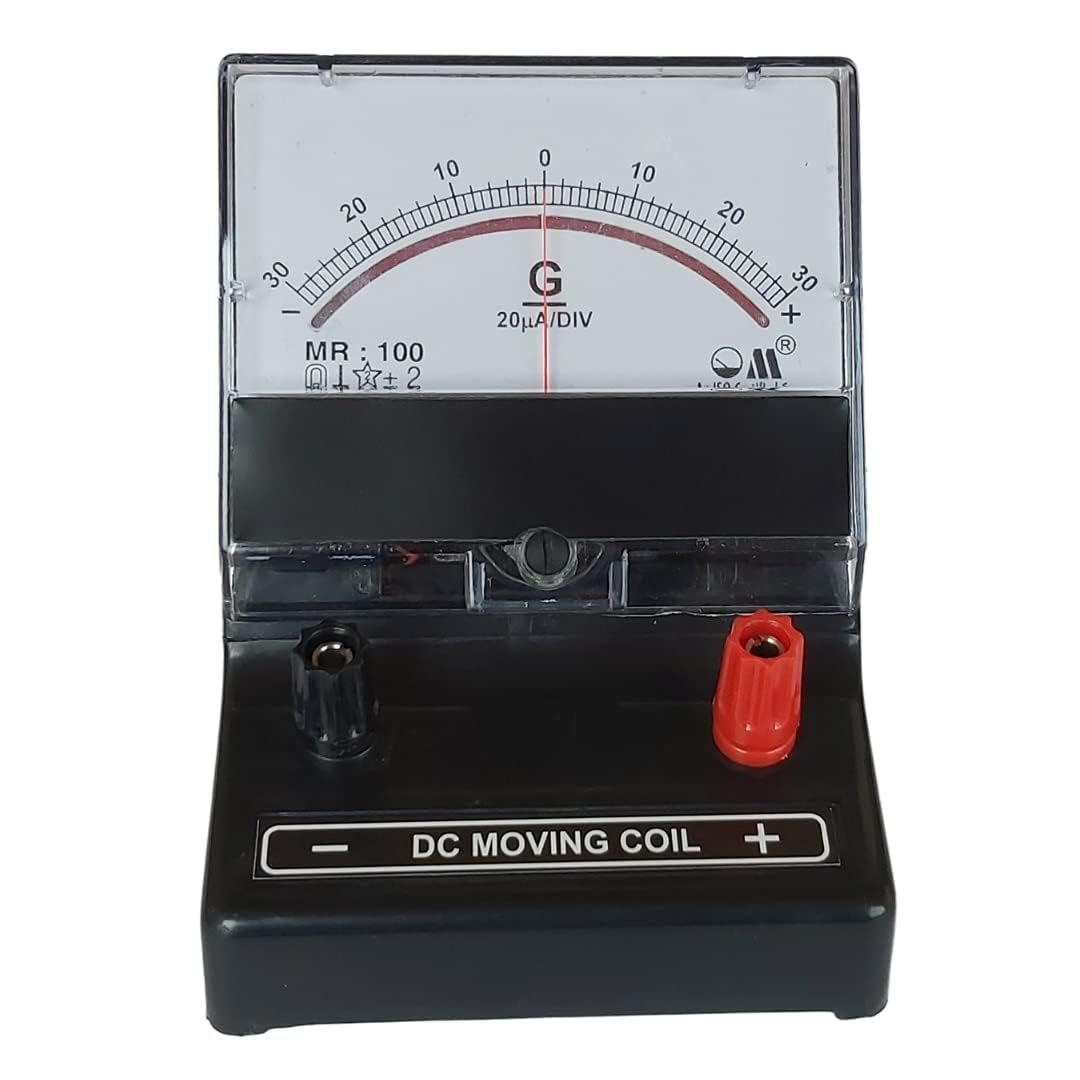
Desk Stand Analog 30-0-30 (20uA/Div) Moving Coil Galvanometer – Black Colour
Product Description & Key Specifications
What it is
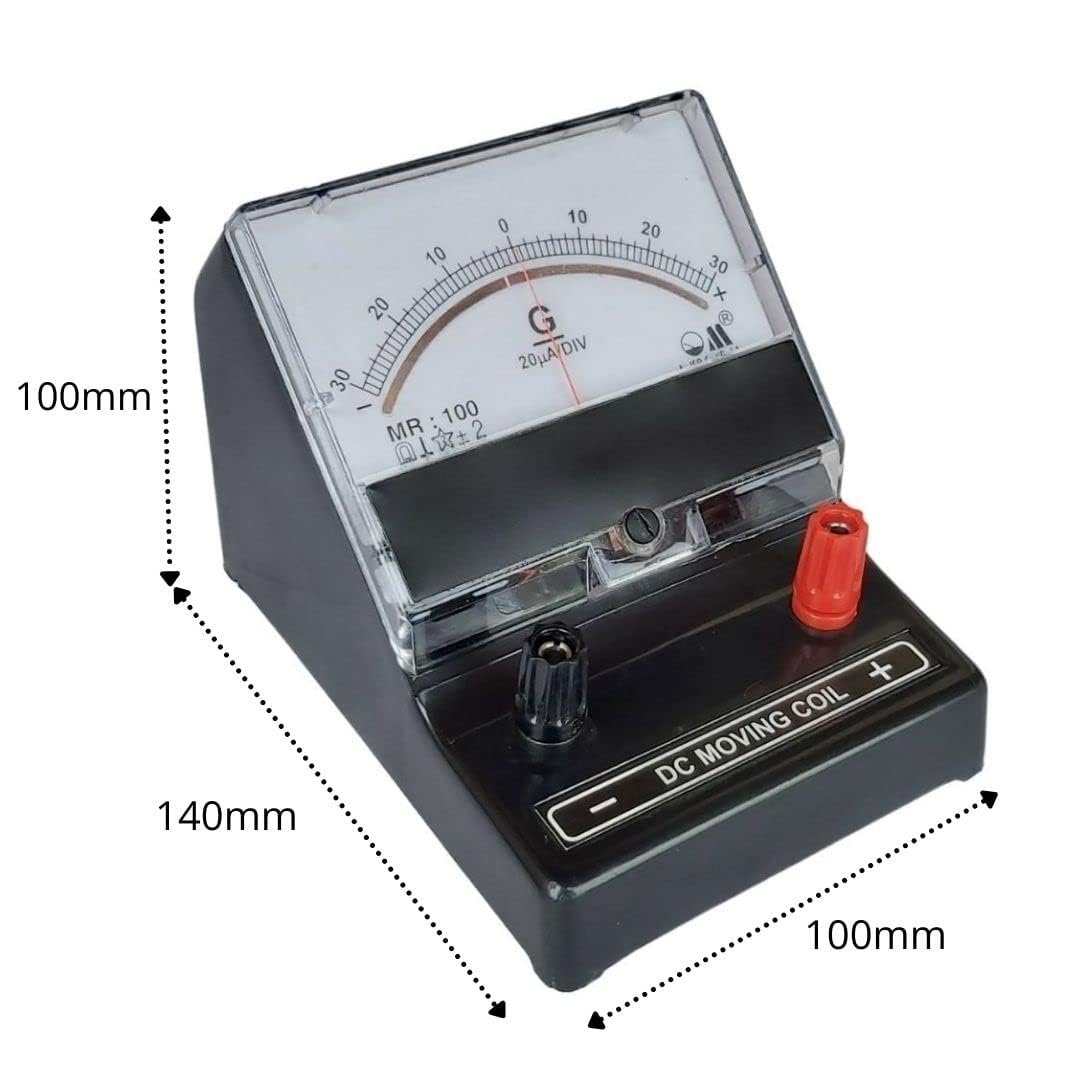
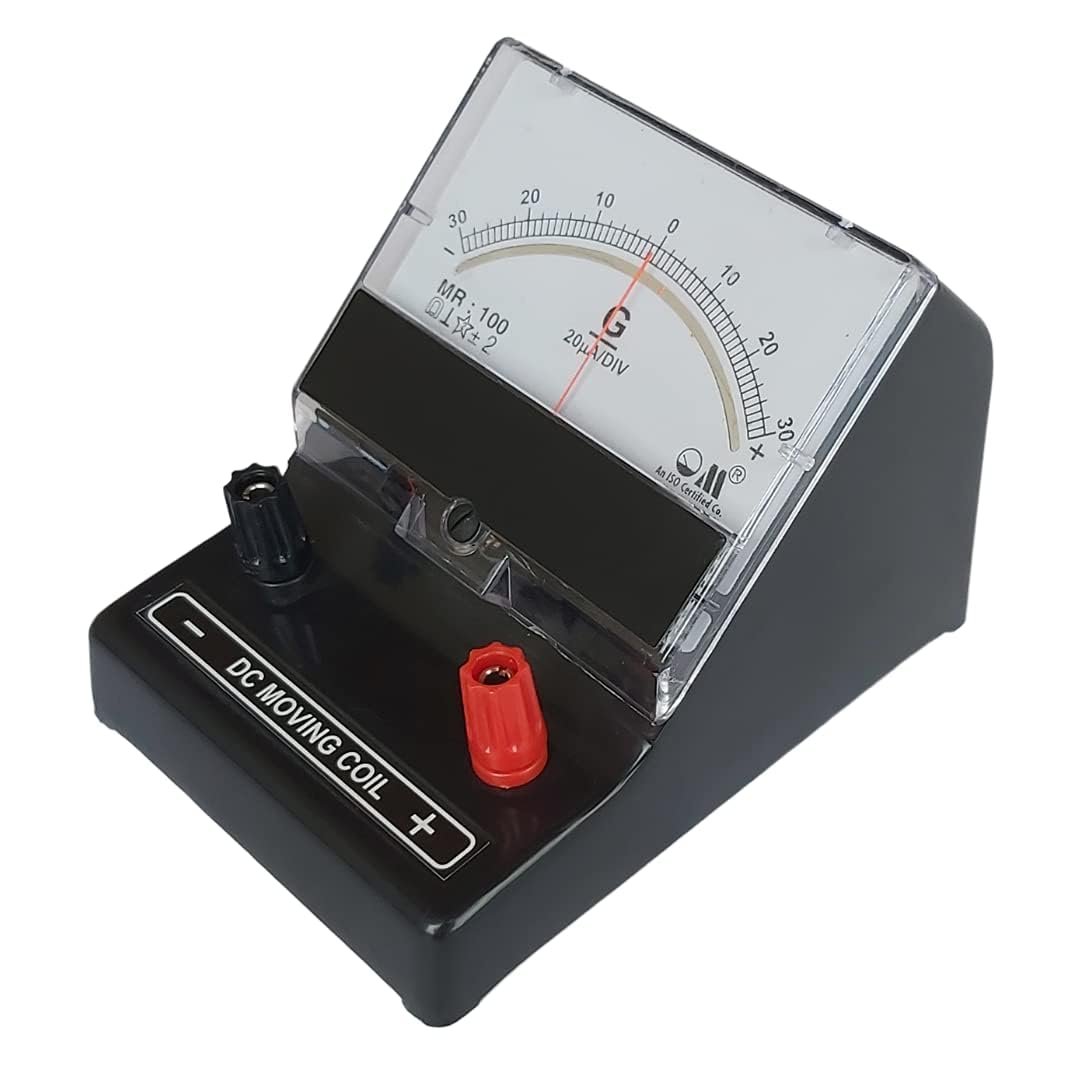
This is an analog moving-coil galvanometer mounted on a desk stand, designed for laboratory use. In this case:
-
Scale: 30-0-30 (means the pointer can deflect 30 divisions in the positive direction, 0 at centre, 30 in the negative)
-
Sensitivity: 20 µA per division (i.e., every division on the scale corresponds to 20 microamperes of current)
-
Colour / finish: Black (in the listing: “Black … desk stand analog 30-0-30 (20µA/Div) moving coil galvanometer (Black)”)
-
Mounting: Desk stand type (i.e., has its own base/stand so you can place it on a bench)
-
Usage: For measuring small DC currents in laboratory experiments (physics labs, engineering labs) using a moving-coil type galvanometer.
Additional Specification Highlights (from available data)
From the MR-100 variant:
-
Case: ABS plastic (in some versions)
-
Accuracy: ±2% of full-scale deflection (F.S.D) in some models.
-
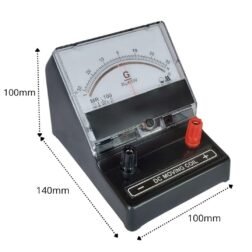
Dimensions: Example listed for MR-100: about 100mm × 100mm × 140mm.
-
Scale length: In one listing ~80 mm approximate for the 30-0-30 (20µA/div) model.
-
Weight: Example ~300 g approx for a particular version.
-
Mounting style: Front terminal, stand-type base etc.
What “30-0-30 (20 µA/Div)” means
-
The “30-0-30” indicates the full-scale deflection is ±30 divisions from the centre zero.
-
With “20 µA/Div”, one division equals 20 microamperes. So full deflection (30 divisions) corresponds to 30 × 20 µA = 600 µA (0.6 mA) in that direction, and similarly in the negative direction.
-
The moving-coil galvanometer works by the coil in a magnetic field being deflected proportionally to current
Construction / Features
-
Moving coil type: a fine coil wound on a frame, suspended in a magnetic field, with a pointer that deflects when current passes. The deflection is proportional to current (for small currents).
-
Desk stand: Means the instrument is mounted such that it can stand on a bench, making it convenient for experiments.
-
Black-colour finish: This particular listing emphasises “Black” in the description (e.g., “…Galvanometer (Black)”).
-
Portable / compact for lab use: Some listings mention “portable and compact” design.
✅ Applications & Use-Cases
-
Ideal for measurement of small DC currents in physics/engineering laboratory experiments (for example: ● Wheatstone bridges, ● null/detection experiments, ● demonstration of current flow).
-
Educational labs: Suitable for school/college practicals where students need to see current deflection. Example listing: “School & Colleges Lab experiment – galvanometer – for science lab.”Research or prototyping where measuring micro‐ampere level currents is required.
-
Demonstrations of principles of electromagnetic measurement devices: useful since the scale is symmetric (30-0-30) and shows positive/negative deflection, which helps illustrate direction of current.
⚠️ Things to Check / Consider Before Buying or Using
-
Range & sensitivity: Ensure the 20 µA/div suits your experiment. If your current flow is much higher or much lower, either you’ll not use much of the scale or you risk saturation.
-
Accuracy: Some models list ±2% F.S.D (full scale deflection) as accuracy. If you need higher precision, check spec sheet. (For example: listing mentioned “Accuracy: ±2 F.S.D.”)
-
Scale readability: Since it’s analog, check that the scale divisions are clear, pointer is sharp, and parallax error is minimised (some units may have anti-parallax mirror). One listing even mentions “anti-parallax mirror” for pointer reading.
-
Mounting stability: Desk stand should be stable so that vibrations or bench movement don’t affect readings.
-
Coil resistance & circuit compatibility: Galvanometers typically have low coil resistance; ensure your circuit can safely connect to it without loading or altering measurement significantly.
-
Direction of deflection: The 30-0-30 gives you both positive and negative deflection; your experiment should permit centred zero, or you might need modifications.
-
Durability: Since moving parts are involved (coil, springs, bearings), check build quality. Some models use ABS plastic case; while adequate, might be less robust than metal. Extract: “Case: ABS Plastic …”
-
Calibration / zeroing: Before use, ensure pointer is truly at zero when no current passes; if not, you may need to adjust or compensate.

Dingman Mouth Gag with Tongue Plates Ent surgical Instrument
Laproscopic Needle Holder Curved 5 mm Ethicon Type Premium Laparoscopy Instruments with Matte Finish
Bipolar Forceps Cautery Teflon Coated for longer durability Fine Tip Reusable bayonet Forceps
Antrum Curette Ent Instrumment
Antrum Backward Punch Ent Surgical Instrument
Laproscopic Spoon Forcep Premium Quality Laproscopy Instruments
Port Closure Laproscopic 5 mm Forcep
Malleus Nippers Ent Surgical Instrumment
Laproscopic Veres Needle Laproscopy Instrument
Rosen Elevator Ent Instrumment
Joseph Nasal Rasp Rhinoplasty Ent surgical Instrument 


Reviews
There are no reviews yet.